“Let All the Earth Be Silent” (Part 2 of 2)
Ministries > Truth For Life with Alistair Begg
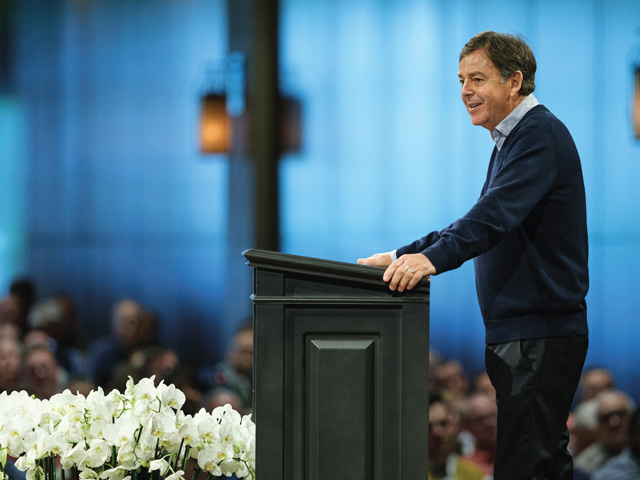
 Habakkuk questioned God’s tolerance of violence, immorality, and idolatry amongst God’s people—issues that remain prevalent today. Do you find yourself joining the prophet in questioning such tolerance? Hear God’s response, on Truth For Life with Alistair Begg.
-----------------------------------------
• Click here and look for "FROM THE SERMON" to stream or read the full message.
• This program is part of the series A Study in Habakkuk’
• Learn more about our current resource, request your copy with a donation of any amount.
• If you struggle to pray because your mind drifts, you don't know what to say, or you even question if God is listening and able to answer, transform your prayer life by learning to pray like the apostle Paul! ‘Download the free audiobook Pray Big by Alistair Begg.’
Helpful Resources
- Learn about God's salvation plan
- Read our most recent articles
- Subscribe to our daily devotional
Follow Us
YouTube | Instagram | Facebook | X
This listener-funded program features the clear, relevant Bible teaching of Alistair Begg. Today’s program and nearly 3,000 messages can be streamed and shared for free at tfl.org thanks to the generous giving from monthly donors called Truthpartners. Learn more about this Gospel-sharing team or become one today. Thanks for listening to Truth For Life!
Bob Lepine: In the Old Testament book of Habakkuk, we find an overwhelmed prophet questioning God's tolerance of violence and immorality and idolatry, even among God's people. These issues remain prevalent in our day. So has God given up? Do you ever find yourself tempted to join the prophet in questioning God's tolerance of wickedness? On Truth for Life Weekend, Alistair Begg walks us through God's response to the prophet's questions. We're looking at Habakkuk chapter two.
Alistair Begg: This revelation which is the answer to Habakkuk's question, God tells him, is marked by four things. Let me just point them out to you. Number one, write down the revelation, make it plain so that someone can run and read it. For the revelation, number one, awaits an appointed time. From Habakkuk's position, everything else is just going on as usual. A time to be born, a time to die, and so it goes on. From his perspective, it just seems as though history is entirely cyclical. It looks as though it's going around and around and around. God says, "No, I want you to write this down, write it down clear. What I am doing has an appointed time. I haven't disclosed the time to you, but I know what the time is. Trust me." Number two, it speaks of the end. You'll see it there in verse three. It will not prove false. Though it apparently lingers, wait for it. It will certainly come and will not delay. Now, Habakkuk has to take all of that as per God's word to him. And we could apply that, of course, in many ways and have benefit from considering its truth in relationship to all that still awaits the unfolding of God's purpose in terms of the end of time and the return of Jesus and so on. Now, in verses four and five, he contrasts the righteous life, which is lived by faith, with the proud boasts and the activities that mark those who are puffed up and live for themselves. This is a pretty difficult little section here as it turns out, but the best I can do with it is this. That when he says, "See, he is puffed up, he is puffed up," either what we have is the epitome of the Babylonian, or if you like, the description of the ruler of the Babylonians as being emblematic of that entire people. He is puffed up. He's on the wrong track. He is betrayed by wine, or it may actually be wealth. Both words are similar in Hebrew and the translators disagree over it. So let's just say both. The puffed-up individual is betrayed both by wine and by wealth. He's arrogant, never at rest, greedy, dissatisfied, and he swallows nations whole. You get this picture, it's a kind of Monty Python's Flying Circus picture. Remember when they did all the little animated things and then the big head would come and then it would start eating things like trains and everything and move all across the screen? It looks about the 1940s now when you see it, but it was very futuristic then. And what you have here is the picture of this puffed-up individual, the ruler of the Babylonians, and he just moves across and he eats nations. He just gobbles them all up as he goes. So from the Lord's answer, we turn to the Lord's judgment. The Lord's judgment is expressed in a succession of five woes. Woe. You may remember in Matthew chapter 23 that Jesus uses the same mechanism when he gives the Pharisees a jolly good ticking off. "Woe to you," he says, "you do this and you do that and you shouldn't." He's employing this Old Testament mechanism. And here in these five areas, he pictures people taunting the proud boasts of this apparently unconquerable force. Now, what I've done is I've just tried to give a heading to each of these five, and we daren't work our way through them or we'll be here long into tomorrow morning. And if you don't like my heading, get your own heading. All right? First of all, in verses six to eight: injustice. Injustice. "Woe to him who piles up stolen goods and makes himself wealthy by extortion." "You have plundered," verse eight, "many nations." In other words, he sounds out a woe to the nation that has conquered lands to which it has no moral right, that has gone and taken for itself something that doesn't belong to it, for whatever reason, usually on the strength of tyranny or the desire simply to have more than we have. Tempted to pile up stolen goods, guilty of dealing unfairly, being involved in extortion. You will find all of these words and notions in this little section, six to eight. And what he says is what you've piled up will come down on your head. You thought it was a great idea to come in here and vanquish these people and plunder these people and take over everything and call it your own. Well, guess what? It'll come down and land on your head. I'm going to have to stop myself from making tangential points of application, but every selfish human empire in the history of humanity has proved this to be the case. "Rule Britannia, Britannia rules the waves." That's what we sang coming out of school, 1957, on the school bus going home. "We're in charge of the universe," we sang to ourselves. Well, it all came down on our heads. Secondly, in verses nine to eleven, woe to those who make failed attempts at security. "Woe to him who builds his realm by unjust gain," there's injustice again, "to set his nest on high." And he does so in order to escape the clutches of ruin, to escape the clutches of ruin. I looked at that little phrase, "to set his nest on high," and only one name out of all of history came to mind. And what was the name? To set his nest on high. Who had a nest on high? Hitler. His Eagle's Nest, built for him on his 50th birthday so that the Third Reich might go there and take tea. The Kehlsteinhaus. The tea house. So that these most brutal of totalitarian rulers may sit in pristine beauty and drink tea. And look, the stones of the wall will cry out and the beams of the woodwork will echo it. And they do. And they do. Thirdly, verses twelve to fourteen: cruelty. Cruelty. "Woe to him who builds a city with bloodshed and establishes a town by crime." Who holds life cheap, who uses the workers to build and beautify his temple and his palace and his own place, who watches slaves die under the blows of the taskmasters. There will be blood. And look at the futility of it. "Has not the Lord Almighty determined that the people's labor is only fuel for the fire, that the nations exhaust themselves for nothing?" For nothing. At the end of the day, when the wind has blown and when time has done its work, and when political forces have arisen and others have collapsed, all of their great endeavors with all of their bloodshed and all their crime-filled towns just amount to nothing at all. Fourth woe is on immorality, fifteen to seventeen. Consider the people stripped, not only of their clothes but of their honor and of their dignity. "You will be filled with shame," verse sixteen, "instead of glory." Now you will notice that all of these little woes have a certain elasticity about them, and purposefully so. Habakkuk is not tying these things to a moment in time, nor to a particular people. He is speaking under the direction of God's Spirit, and there is a sense in which as he makes this succession of woes, the phrase that comes to mind is "If the cap fits, wear it. If the cap fits, wear it." And you can determine at what point you want the American empire to get on board with this drama. But we're pretty close right here, aren't we? The capital of the pornographic Western world is here in the United States. "Woe to him who gives drink to his neighbors, gazing on their naked bodies." And notice the violence in verse seventeen is a violence that's been done alongside this immorality, a violence done to Lebanon which will overwhelm you. That sets it in an immediate point of application in relationship to geography. "And your destruction of animals will terrify you." I read that phrase and I said, "Now what in the world are we dealing with here?" And then, "You have shed man's blood. You've destroyed lands and cities and everyone in them." It's impossible to miss this. God expresses his judgment upon those who play fast and loose with creation. What is this but a devastation of nature? What did they do to Lebanon? What's Lebanon known for? Its forests. Its forests. The violence you've done to Lebanon will overwhelm you. The way you've treated animals will terrify you. The way you shed human blood indiscriminately will cry against you. I say to you again that to be a Christian is to have a view about everything in the world. Everything in the world. The Christian's response to ecology is a Christian response. It is a Bible response. The Christian's view of the doctrine of creation is guarded and guided by the Bible. So the fact that we know that all creation groans in travail waiting for the redemption of the sons of men does not mean that we're supposed to say, "See, therefore it doesn't matter." No, we're supposed to, on the basis of our understanding of what the Bible says, deal with it in a way that cares for that which God has given us to enjoy. We can't sing about "Through the woods and forest glades I wander" on the one hand, and then just torch the place on the other. Not unless we want just to be a walking contradiction, which of course is part of our dilemma. And the fifth and final woe, in verses eighteen to twenty, is the woe against idolatry. Idolatry. Of what value is an idol? No value at all. "Woe to him who says to wood, 'Come to life,' or to lifeless stone, 'Wake up.'" Absolutely useless. I'm tempted to read to you from David Wells's book, but I'm not going to because it would take too long and I would violate my own desires and designs for the evening. But I have an unbelievably wonderful quote out of David Wells's latest book entitled *The Courage to be Protestant*, and I was going to quote to you from page 164 and 165 and 166. So we'll just leave it right here. You can read it afterwards. But his point is: the idolatry of 21st-century America is the idolatry of me. It's the idolatry of the self. And again, if the cap fits, wear it. Of what value is an idol? That we would look inside of ourselves for God? That we would look to ourselves for our own answers? All of that is simply idolatry. The Lord's answer then, the Lord's judgment, and finally, the Lord's glory. The Lord's glory. Next time in verse two of chapter three, we will be confronted by that wonderful little call of Habakkuk to God: "In wrath, remember mercy." When he sees all that is unfolding in God's judgment, he cries out to God to show mercy. And of course the whole story of the Bible is that God's righteous judgment on sin is always accompanied by his mercy. So that when Adam and Eve are banished from the Garden of Eden and the angels are there with flaming swords to prevent their reentry, it is God who then comes to them in their nakedness and provides coverings for them, an expression of his mercy in the execution of his judgment. And when God sounds out his judgment upon the earth and calls people to repentance, he raises up his servant Noah, and Noah has charge with the prophetic responsibility of saying to people, "God is justifiably angry with the state of affairs and he's coming in judgment and he is going to flood the world. But he wants you to know that he has provided here a way of escape because in the execution of his wrath, he is preferring you and offering you mercy." And at the cross of the Lord Jesus Christ, as his wrath is poured out upon all the sinfulness and wickedness of man, in that very scene is the expression of his merciful love to all those who will hide under the shadow of what that cross provides. So when you read chapter two again later in the week, as I think some of you may, and you go through all of these woes, make sure that you finish up by noticing verse twenty. The Lord is in heaven, therefore shut up. That's what he says. The Lord is in heaven, therefore let the earth be silent. Let the earth be silent. And then notice in verse fourteen, if you're tempted to doubt that it's all going pear-shaped, that everything is going horribly wrong, know this: "The earth will be filled with the knowledge of the glory of God as the waters cover the sea." All the proud kingdoms of time will pass away, but God's kingdom stands and grows forever. And the pathway of the righteous, verse four, is the pathway of faith. "And the righteous will live by his faith." And of course that verse is picked up and employed by Paul and by the writer of the Hebrews and pressed into service at the time of the Reformation both by Calvin and by Luther as a very cornerstone of the nature of Christian living itself. So that not by our endeavors, by our good deeds, by our attempts at righteousness, but on account of the provision of a righteousness that we are undeserving of and could never gain. The conduit of which is our faith, is our childlike trust. For the only thing that we bring to our Christian lives is the sin of which we need to be forgiven. And then on that pathway of faith, we come with our complaints and our questions and seek the Lord's answer. Yes, a painful answer, for it speaks of his judgment. But in the midst of that judgment, an expression of his mercy, which speaks of his glory. Therefore, says Paul, being justified by faith, we have peace with God through our Lord Jesus Christ, through whom we have gained access by faith into this grace in which we now stand. And we rejoice in the hope of the glory of God. We rejoice in the certainty of God's manifestation of himself. So Habakkuk, hang on. I know what I'm doing and it won't be late and it won't be premature. It will be at the right time. Some of us have illnesses that we would like healing for right now. And God says, "Hang on." We don't like the answer, but it is his answer. But in his own appointed time, he will accomplish his purposes. So let us learn with Habakkuk to wait on him.
Bob Lepine: You're listening to Truth For Life Weekend with Alistair Begg. Alistair returns in just a moment to close today's program. As we are finding out, even the prophets struggled to understand God's ways and his timing. But as Alistair reminded us today: hang on, God knows what he's doing and it will be at just the right time. The more we understand about God's holiness, his mercy, and his love for people, the easier it becomes to trust him, to wait on his timing, and grasp the seriousness of his wrath. That's why our mission at Truth for Life is to teach the Bible every day. we trust God to work through the teaching of his word on this program to bring unbelievers to saving faith, to establish believers in their faith, and to build up local churches. In addition to the teaching you hear on this program, we offer free or at-cost resources to help you grow in your faith. Today at Truth for Life, you can download the audio version of Alistair's book *Pray Big: Learn to Pray Like an Apostle* for free. And if, like most of us, you struggle with prayer, Alistair provides guidance and direction to help you understand how to pray, why to pray, and what to say. He draws from the Apostle Paul's prayers for the Ephesians to teach you how you can stay focused as you pray, how to enrich your time with God, and how to pray with boldness. You can get started right away. The audiobook comes with a companion study guide, and you can download both for free right now, today, at truthforlife.org/praybig. Now here's Alistair to close with prayer.
Alistair Begg: Father, help us to make sure that we bring all our questions to the one who has the answers, to you, the omniscient, gracious, living, loving God. And then help us so to bring the truth of your answer to bear upon our lives, so that as we view our own circumstances and the issues represented in the history of our world, that we might increasingly think in a biblical way. That our Christianity will not be something that isolates us from our society and from the world in which we live, but allows us to think properly and to live rightly. Forgive us for all the times when we want to live in splendid isolation, to pretend that nothing's happened, to think that somehow we can just shoo it all away. Unless you come, O God, unless you execute your judgment and in so doing show us mercy, we are without God and without hope. But know that cannot be because as we have just read, we actually have in Jesus a hope that goes out beyond the bounds of our own small time frame. Fill us then with hope, send us out in hope, so that we might speak of hope to our friends and our neighbors who feel that life is increasingly fractured and futile and hopeless. For we pray in Christ's name, Amen.
Bob Lepine: I'm Bob Lepine, we appreciate you taking the time out of your weekend to study the Bible with us. How is it possible to move from feeling overwhelmed to rejoicing even when circumstances remain unchanged? Next weekend, we'll hear the answer. The Bible teaching of Alistair Begg is furnished by Truth for Life, where the learning is for living.
Related Episodes
Supper with the Savior
Friday, September 25
Grace and Forgiveness (Part 2 of 2)
Thursday, September 24
Grace and Forgiveness (Part 1 of 2)
Wednesday, September 23
About Truth For Life
Truth For Life distributes the unique, expositional Bible teaching of Alistair Begg. Studying God’s Word each day, verse by verse, is the hallmark of this ministry. In a desire to share the good news of the Gospel without cost as a barrier, the entire teaching archive is available for free download and resources are available at cost with no markup.
About Alistair Begg
Alistair Begg has been in pastoral ministry since 1975. Following graduation from The London School of Theology, he served eight years in Scotland at both Charlotte Chapel in Edinburgh and Hamilton Baptist Church. In 1983, he became the senior pastor at Parkside Church near Cleveland, Ohio. He has written several books and is heard daily and weekly on the radio program, Truth For Life. The teaching on Truth For Life stems from the week by week Bible teaching at Parkside Church. He and his wife, Susan, were married in 1975 and they have three grown children.Contact Truth For Life with Alistair Begg
Website
http://www.truthforlife.org/?utm_source=oneplace&utm_medium=sitelinks&utm_campaign=home
Mailing Address
Truth For Life
P.O. Box 398000
Cleveland OH 44139
Telephone (Customer Service)
888-588-7884 Domestic
400-543-6800 International
440-543-0522 ( Fax)


