Mark Intro—1:3
Ministries > Thru the Bible with Dr. J. Vernon McGee
https://www.oneplace.com/ministries/thru-the-bible-with-j-vernon-mcgee/
Facebook Twitter Instagram YouTubeWelcome to the book of Mark. Don’t blink, or you’ll miss something good. The key word in Mark is “immediately.” Jesus was a busy guy. He ministered to people constantly and immediately, pouring out love and compassion at every turn He took. Discover Jesus as the humble Servant who tends to wounds, brings blind eyes sight, and even stops death.
References
Steve Schwartz: Welcome to Through the Bible with teacher Dr. J. Vernon McGee. We're back in the New Testament beginning our study in the Gospel of Mark. Now you probably know this, but the Gospels are all about the life and ministry of Jesus. Four Gospels, four personal perspectives, same Jesus. When we recently studied Matthew, we got a picture of Jesus from a Jewish man writing to Jewish readers showing that Jesus was the Messiah, the king of the Jews. Now we begin the Gospel of Mark. And although John Mark was not a disciple of Jesus during Jesus' earthly ministry, he accompanied the apostle Peter in his ministry. Mark based his Gospel on Peter's eyewitness account. Fascinating, isn't it? So find your seat on the Bible bus and open your copy of God's word. And while you do that, here's a great letter from a fellow passenger named Lamar. I first heard Dr. McGee on the radio while on the way to work in the early '80s. Since I am a Texan, I loved his voice and it was like hearing an old friend. I made sure I was in the car on my commute when the program aired. It helped me understand more of the word of God and each program explained each chapter. Unfortunately, as I was a young man not centered in the precepts of Christianity, even though I accepted Jesus Christ as my savior at the age of 12, I foolishly strayed from my walk with him for many years. Fortunately, in his abundant grace and mercy, he never left me and his spirit constantly convicted me of the sin in my life. I returned to the fold as a prodigal son and he received me with open arms. Now I'm using the app daily and I'm on the Bible bus joyfully studying the word again. My heart and mind are being transformed and it helps tremendously when I speak with others about his everlasting love for us wretched sinners. I thank God for his patience and love for me. I was delivered from addiction and strive to please the Lord instead of myself, crucifying my flesh so that I can become what he wants me to be is a daily battle. I have the KJV Bible with Dr. J. Vernon McGee's notes and outlines and have gifted them to friends. It's a great resource for understanding the word. I thank God for this ministry that continues to this day. It has been a long hard journey for me, but with God's help, I will be victorious in Christ Jesus. May God richly bless you all for the work you do. Well, what a great note. Thanks, Lamar. Many families who study with us do have prodigals. I've got one myself and I'm sure that your note gives them hope as it does me. Let's pray. Father, thank you for your compassion and grace. We ask that you bring those who have strayed home to the fold. And for the rest of us, Lord, fill us with your spirit so that we may experience the fullness of your life in us. We pray this in Jesus' name. Amen. We're off to the book of Mark on Through the Bible with Dr. J. Vernon McGee.
Dr. J. Vernon McGee: Now the Gospel of Mark that we come to now is actually, chronologically, the first Gospel that was written. It was actually one of the first books written in the New Testament, not the first, but one of the first. And this man John Mark, and I'm going to spend a little time now in introduction to the Gospel of Mark. John Mark was one of the writers who was actually not an apostle. Matthew was and of course John was. And Luke was a very close friend and an intimate of Paul the apostle. And John Mark was one who went with Paul on the first missionary journey. He was the nephew of Barnabas. Now John was his Jewish name, while Mark was his Latin surname. Over in Acts 12:12 we read, and when he had considered the thing, he came to the house of Mary, the mother of John, whose surname was Mark, where many were gathered together praying. That was when Simon Peter was released from prison. Now actually, this is the first historical reference to him that we have in scripture. Obviously, his mother was a wealthy and prominent Christian in the Jerusalem church. And evidently, the church there met in her home. He was a nephew of Barnabas. And Paul tells us that in Colossians 4:10 and he evidently was the spiritual son of Simon Peter because Peter writing in his first epistle in the fifth chapter verse 13 says, the church that is at Babylon, elected together with you, saluteth you. And so doth Marcus, my son. Now the Gospel of Mark has long been considered by the way Simon Peter's Gospel. And I think there's evidence for that. We'll see that a little more closely in a moment. And John Mark joined Paul and Barnabas before the first missionary journey. Actually, we are told in Acts 13:5 and when they were at Salamis, they preached the word of God in the synagogues of the Jews. And they also had John to their minister. But this man, of course, he turned back at Perga and Pamphylia. And uh apparently, it was um fact that he was maybe a little yella. Maybe he was chicken as we would say today using a commonplace. And we don't need, I think, to defend John Mark for turning back. He may have had an excuse. I don't know, but it looks to me like that he had failed and at least he did make good. But Paul didn't want to take him on the second missionary journey and Uncle Barnabas did. He was a great fellow and was easy to forgive, but not Paul. In Acts 15 verse 37 and 38 I read and Barnabas determined to take with them John, whose surname was Mark, but Paul thought it not good to take him with them, who departed from them from Pamphylia and went not with them to the work. Uh that looks to me like Paul thought he failed him. And we're told in verse 39 there in Acts 15 and the contention was so sharp between them, they departed asunder, one from the other. And so Barnabas took Mark and sailed unto Cyprus. And far as we're concerned, sails right off the pages of scripture. And we know very little about his ministry and John Mark, but we do know that John Mark made good when Paul wrote his swan song in 2 Timothy, the fourth chapter verse 11, he says, only Luke is with me. Take Mark and bring him with thee, for he's profitable to me for the ministry. So that John Mark made good. There's always been a question of whether he occurs somewhere in the Gospel record. Well, I'll call attention to that. I personally don't think that there's any basis for that at all. And we are told that this man Mark got his facts of the Gospel from Peter. And others say that he got the explanation of the Gospel from Paul. Well, I'm willing to accept that, but I would like to now back up for just a minute in this introduction and look at this matter of the four Gospels. Why four Gospels? And we have said that Matthew was written for the nation Israel, was written for the religious man. Now Mark was written specifically for the Roman. And it was suited for the Roman mind. It was written for the strong man. And they were the ones that rule the world and ruled it for a millennium. And the Gospel of Mark is slanted in that direction, by the way. The Romans actually had subjugated the world. And they brought peace and justice and good roads and law and order and protection. But they forced peace on the world. The iron heel of Rome was on mankind. And what a price it was to pay. It was a strong dictatorship. And Dr. Gregoris expressed it like this. The Roman was to try whether human power, taking the form of law regulated by political principles of which a regard for law and justice was most conspicuous could perfect humanity by subordinating the individual to the state and making the state universal. That is a tremendous statement by the way. And Culver in his book on Daniel has a statement. I'm not giving the exact quotation, but the sense of it is that the Roman gave to the world the kind of peace that the League of Nations and now the United Nations is trying to give to the world. But it's been tried by the Romans and it has to be a peace that is pushed down on the world, forced on the world. And it has to be in the hands of a very strong man. And the world today, of course, is looking again for that strong man to come along. Now the Roman was looking for that kind of a person. Rome represented active human power in the ancient world. And it did lead to dictatorship and power vested actually in one man. And that of course was the thing that was dangerous. That's the thing that's dangerous right now, for that's the way that we are moving today. And you find that again, and I'd like to quote Gregary in this connection, he says that the Roman was the mightiest worker, the conqueror, the organizer, and the ruler. The man who is Caesar could sway the scepter of the Universal Empire. Caesar and Caesarism were the inevitable last result of Roman development. And when he had been made to feel most deeply that natural justice in the hands of a human despot is a dreadful thing for sinful man, the Holy Spirit proposes to command to his acceptance Jesus of Nazareth as his sovereign and savior, the expected deliverer of the world. And we're moving into a position today where there will come in a police state one man and he'll be satanic, ruling over sinful man. And they'll cry out for deliverance. And the only one that will be able to deliver will be the Lord Jesus Christ when he comes. When Paul wrote to the Romans, he could say, I'm not ashamed of the Gospel of Christ, for it's the power of God unto salvation. And that power is a power that can expand mercy. And in the days when the Caesars Rome, the world longed for mercy and all like got was power. And it was a day when no man dared resist that power. To resist it was fatal and to flee was impossible. You could never get beyond it. And it was in that day that God sent a message to this segment of the population. And John Mark is the writer. But as we've said, he's giving Simon Peter's account of the Gospel. And you'll find out that that was the position that many in the early church took. They felt that. I'd like to quote, for instance, Papias. Papias, one of the early church fathers, he recorded that John Mark got his Gospel from Simon Peter. And I'm quoting him now exactly. Mark, the interpreter of Peter, wrote carefully down all that he recollected, but not according to the order of Christ speaking our work, which by the way is quite interesting. And Eusebius says that such a light of piety shown into the minds of those who heard Peter that they were not satisfied with once hearing nor with the unwritten doctrine that was delivered, but earnestly besought Mark that he would leave in writing for them the doctrine which they had received by preaching. And so it was. Actually, we get Simon Peter's Gospel and it's a Gospel of action. Simon Peter, by the way, was that kind of a man. And so when you come to the Gospel of Mark, it 's a Gospel of action. The Lord Jesus here lays aside his robes of royalty, those regal robes we saw in Matthew. And he girds himself with the towel of service and he moves in and he's a man of action. He is the king in Matthew. He is the servant in the Gospel of Mark, not man's servant. He's God's servant. And it is a Gospel that frankly you can divide in a most unusual way. I like to divide the four Gospels according to a newspaper. For instance, Matthew carries the advertising and announcements. Behold, the kingdom of heaven is at hand. Dr. Luke carries the special features. He gives us the songs of Christmas and the parables of the good Samaritan and the prodigal son. And he majors in those. Now John carries the editorials and the columnists, the different columns that are written. He has the discourse on the bread of life, the light of the world, and the upper room discourse. But John Mark carries the flaming headlines. Jesus came. That's one of his expressions. Jesus only. And then he is risen. These are headlines that you find in the Gospel of Mark. And Mark expresses it by stating the words of our Lord in Mark 10:45, for even the son of man came not to be ministered unto, but to minister and to give his life a ransom for many. And you have here, behold my servant whom I uphold, mine elect in whom my soul delighteth. I put my spirit upon him. And that's Isaiah 42:1. And you find that Bernard in the Bampton Lectures way back in 1864 said of Mark, St. Peter saying to Cornelius has been well noticed as a fit motto for this Gospel. God anointed Jesus of Nazareth with the Holy Ghost and with power, who went about doing good and healing all those who were oppressed of the devil. Someone is put it like this. I read in a book where a man called Christ went about doing good. It's very disconcerting to me that I'm so easily satisfied with just going about. We hear a great deal today about protesting and marches. And you hear the do-gooders, both the politicians and the preachers. They are all talking about doing good, but they're not doing good. They are just going about but not doing good. The Lord Jesus came in all the winsomeness of his humanity and in the fullness of his deity doing good. But this is only the beginning of the Gospel. He died and rose again and it wasn't until then that he said to his own, go into all the world and preach the Gospel. Without the death and resurrection, these do-gooders are just do-gooders. They just don't do it though. That's the only problem with them. And so you have in the Gospel of Mark a Gospel of action. The style of Mark is brief and blunt, pertinent and pithy, short and sweet. And Mark is stripped of all excess verbage and he goes right to the point. This is the Gospel of action and accomplishment. Here Jesus is not adorned with words and narrative, but he's stripped and girded for action. And Mark is written in a very simple style. It's designed for the mass of the street. It's interesting to note that the connective and occurs more than any other word in the Gospel. Now it is said it occurs 1,331 times. I didn't count that, friends, but if you doubt that figure, you count it. 1,331 times. And very frankly, if I had turned in in college English, well, any kind of a paper with that many ands in it, I'd have been I think flunked for it because they say you ought not to use that, but it's a potent word when it's used right. And very frankly, it is a word of action. It's something that means something has to follow. And that's the reason a lot of new speakers, I've noticed young preachers, they get up and they're reaching for something to say and then they use the word and. And the minute you say and, friend, you got to say something else. You can't stop with that. No sentence can end with and. And leads to action always. And now Mark wrote this Gospel, I believe, in Rome evidently for the Romans. And as we've said, they were the kind of people that wanted one of action. The question was, is Jesus able to do it? Now you'll notice here at the very beginning, there's no genealogy. Well, now why wouldn't you have a genealogy? Well, I think that that's quite obvious why you do not have a genealogy. In Matthew you have one. A king must have a genealogy. But a servant needs references, not a birth certificate. The question is, can he do the job? And we're going to see that in this Gospel. That's the way that he's presented. Now probably I ought to say just a word about the notes that I have and I hope you'll send for them. I have divided the Gospel of Mark in a way that's different from any other division. It's filled with miracles, more miracles than any other. And you find out and I like to give you the outline briefly. John introduces the servant. God the Father identifies the servant. The temptation initiates the servant and works and words illustrate. And you have the miracles divided in miracles of healing, physical. Miracles of nature, natural miracles. The casting out of demons, spiritual miracles. And then raised from the dead supernatural. You have these four major divisions of miracles. And then you have a few parables, not many, and then many other teachings and incidents. And I've divided this Gospel in that way rather than attempting to go through in a logical way and divide each chapter. Now we find here in chapter 1 and we probably should just get our foot in the door after all. John announces and baptizes Jesus. And Jesus is approved by the Father, tempted by Satan. And he begins his ministry in Galilee. He calls four disciples. He casts out demons. He heals Peter's wife's mother and he prays and then he heals a leper. And that apparently was one day's job, all of that he did there beginning yonder in Galilee. Now there's probably more content in this first chapter of Mark than any other chapter in the Bible. You can compare it with Genesis 1. And it covers the ministry of John the Baptist after going back to the prophecies of Isaiah and Malachi. It takes in the first year's ministry of Jesus. Follows him through a busy Sabbath day. And it concludes with a mighty work of cleansing the leper. And in spite of the pressure of a busy life, Jesus took time out to pray. This chapter of crowded content is made striking by the absence of that genealogy, which is prominent in Matthew. But we've already said why. Mark contains his references. It's not a question as to his ancestors. It's rather his actions. Can he do the job? Jehovah's servant is marked out here by his accomplishments. Besides this, the Romans or other outsiders would not be concerned with the genealogy of Jesus, which runs back to Abraham. And that's the reason the Gospel of Matthew is not really the Gospel to hand out to individual for the first time. That genealogy is meaningless, of course. Now will you note this. We are going to look upon the Lord Jesus Christ. We are going to behold him here and as Dr. A. J. Gordon put it, the look saves, but the gaze sanctifies. Now we have the prophecies concerning the coming of John the Baptist here in the first three verses. And I'm reading now the beginning of the Gospel of Jesus Christ, the son of God. As it is written in the prophets. And this is Isaiah. Behold, I send my messenger before thy face, which shall prepare thy way before thee. The voice of one crying in the wilderness. Prepare ye the way of the Lord. Make his paths straight. This is the beginning of the Gospel. Now this is not the beginning of either John or Jesus, by the way, and it's not the beginning that you have in Genesis or in the Gospel of John. This is the beginning of the Gospel. This is when the Lord Jesus came to this earth and died upon a cross and rose again. That, my friend, is the Gospel. And these beginnings tell of his coming into the world, the beginning of his public ministry. And we need to note that because it's very important. And we'll look at that a little more carefully next time. Until then, may God richly bless you, my beloved.
Steve Schwartz: There's more in this great study, so come back next time. Take a few minutes before then to read through Mark chapter 1. In fact, if you can read through the whole book of Mark, it's only 16 chapters. As Dr. McGee mentioned, you'll learn a lot more from our studies when you read the scripture before and after each study. And if you listen on the app, it's really easy to do that. Now we just started a new stretch of the road through the Gospel of Mark and there's plenty of room on the Bible bus. So why don't you invite a friend to come along? Call 1-800-655 Bible and request a pack of Bible bus passes. We haven't talked about those in a while. Each one includes a QR code that links directly to our study. One of those small cards could open the door to a life-changing journey through God's word. So be sure to carry one or two of those along with you in your pocket or wallet. Again, to be in touch, call 1-800-655 Bible or visit ttb.org. You can also write to box 7100 Pasadena, California 91109. In Canada, box 25325 London, Ontario N6C 6B1. I'm Steve Schwartz and I'll save a seat on the Bible bus for you as we make our way through the Bible.
Guest (Male): Through the Bible is a 5-year study of God's entire word and together we discover God's purposes in history and our lives found only when we believe in Jesus Christ. Do you know him yet?
Related Episodes
Exodus 39, 40
Thursday, October 15
Exodus 38
Wednesday, October 14
Exodus 36, 37
Tuesday, October 13
About Thru the Bible
Thru the Bible takes the listener through the entire Bible in just five years, threading back and forth between the Old and New Testaments. You can begin the study at any time. When we have concluded Revelation, we will start over again in Genesis, so if you are with us for five years you will not miss any part of the Bible.
Other Thru the Bible Programs:
Thru the Bible - Minute with McGee
Thru the Bible - Questions & Answers
Thru the Bible - Sunday Sermon
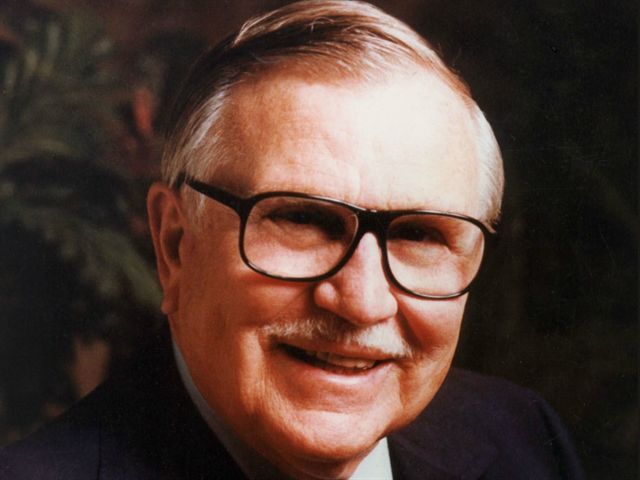
About Dr. J. Vernon McGee
John Vernon McGeewas born in Hillsboro, Texas, in 1904. Dr. McGee remarked, "When I was born and the doctor gave me the customary whack, my mother said that I let out a yell that could be heard on all four borders of Texas!" His Creator well knew that he would need a powerful voice to deliver a powerful message.
After completing his education (including a Th.M. and Th.D. from Dallas Theological Seminary), he and his wife came west, settling in Pasadena, California. Dr. McGee's greatest pastorate was at the historic Church of the Open Door in downtown Los Angeles, where he served from 1949 to 1970.
He began teaching Thru the Bible in 1967. After retiring from the pastorate, he set up radio headquarters in Pasadena, and the radio ministry expanded rapidly. Listeners never seem to tire of Dr. J. Vernon McGee's unique brand of rubber-meets-the-road teaching, or his passion for teaching the whole Word of God.
On the morning of December 1, 1988, Dr. McGee fell asleep in his chair and quietly passed into the presence of his Savior.
Contact Thru the Bible with Dr. J. Vernon McGee
Mailing Address
Thru the Bible, Inc.
P.O. Box 7100
Pasadena, CA 91109
In Canada:
Box 25325,
London, Ontario
N6C 6B1
Phone Number
(626) 795-4145 or
(800) 65-BIBLE (24253)